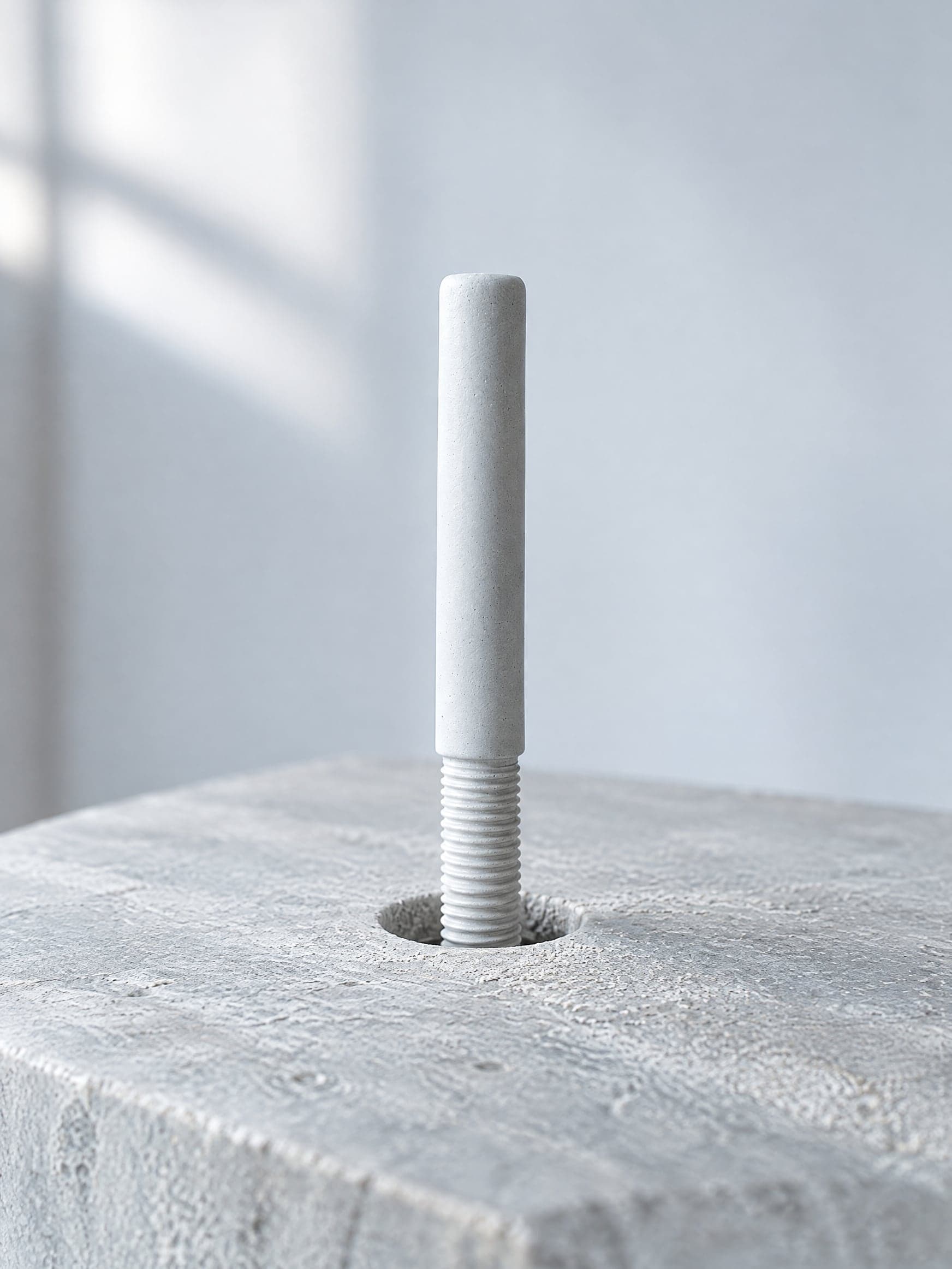
Why do implant surfaces differ by type?
Roughening the surface or adding a coating is done to increase the area the bone can attach to and to speed up the initial response. The implant screw (fixture) is a post placed in the jawbone, and the process of bone attaching to its outer surface is called osseointegration. What the surface mainly changes is "how quickly it first attaches," and it does not rank the results after full attachment.
In the treatment room I am often asked, "If I'm going to do it anyway, the most expensive one bonds best, right?" I see the surface not as a grade but as an option chosen to match the condition of the bone. A more expensive surface is not necessarily a surface that bonds better.
What are the differences between surface types?
Product names differ, but surfaces can be broadly divided into three groups.
| Surface | How it is made | When it is mainly considered |
|---|---|---|
| Rough standard surface | Blasted with particles and etched with acid to make it rough | When there is enough bone and time to wait |
| Hydrophilic surface | Ions or similar are added so blood adheres well | When placing the implant on the same day the tooth is pulled, or when bone quality is weak |
| Bioactive coated surface | Coated with a thin layer close to bone components, such as hydroxyapatite | When bone density is low or initial stability is a concern |
The rough standard surface has been used for a long time, so a lot of long-term data has built up. It may take a little longer to attach, but taking longer does not make it a weak surface. How much faster hydrophilic or coated surfaces are differs from person to person, so I do not state it as a fixed number.
When does the choice of surface become important?
When the bone is weak or healing is slow, I consider a surface that helps early attachment.
- Immediate placement, where the implant is placed on the same day the tooth is pulled
- Areas with low bone density, such as the upper molars
- When initial stability is weak because a bone graft is done at the same time
- When healing is slow because of a general condition such as diabetes
Even then, the surface is a supporting tool. If initial stability cannot be achieved at all, changing the surface does not mean the implant is placed right away; we fill in the bone or wait first, then place it. Cases with insufficient bone are covered in detail in the article bone grafts for implants.
What should be looked at before the surface?
The angle and depth of placement. The thickness and height of the bone, the distance from the neighboring teeth, the position of the nerve and the maxillary sinus (the hollow space above the upper molars), and gum inflammation determine the angle and depth. If this plan is off, the result is unstable no matter which surface is used.
Whether the product name determines the result is summarized separately in the article implant product names.
How we handle it at Wonjin Dental
I first look at the amount of bone and the position of the nerve and maxillary sinus on a panoramic X-ray and three-dimensional (CT) imaging, decide the angle and depth, and then choose the surface. If there is enough bone, I go with a standard surface, and I bring out a surface that helps early attachment only when the bone is weak or immediate placement is needed. I do not change the surface just to raise the price when there is bone to spare.
| Item | Price |
|---|---|
| Osstem implant SA | ₩300,000 |
| Osstem implant BA | ₩500,000 |
| Osstem implant SOI | ₩800,000 |
| Simple bone graft / complex bone graft | ₩150,000 / ₩300,000 |
Prices are as of September 2026, and if you meet the conditions, insurance-covered implants are also possible. Other items can be checked on all treatment fees.
Frequently asked questions
Does a better surface make an implant last longer?
How long it lasts depends more on where it is placed, gum care, biting force, and regular checkups than on the surface. After it has attached to the bone, care that prevents inflammation around the implant is more important.
How long do I wait for it to attach to the bone?
Generally, the wait is about 2–3 months for the lower jaw and about 3–6 months for the upper jaw. Depending on the surface it can be a little shorter, but the condition of the bone and whether a bone graft was done determine the period more.
Can I get an implant if I have diabetes?
If blood sugar is well controlled, it is often possible. Healing can be slower, so I consider a surface that helps early attachment and look at gum inflammation and bone density together.
If the implant type is different, is it harder to repair later?
Parts for products widely used in Korea are relatively easy to get, so tightening the screw or replacing the restoration is often possible at another clinic too. It helps to keep a record of the product name and specifications from your first treatment.