What are lingual braces?
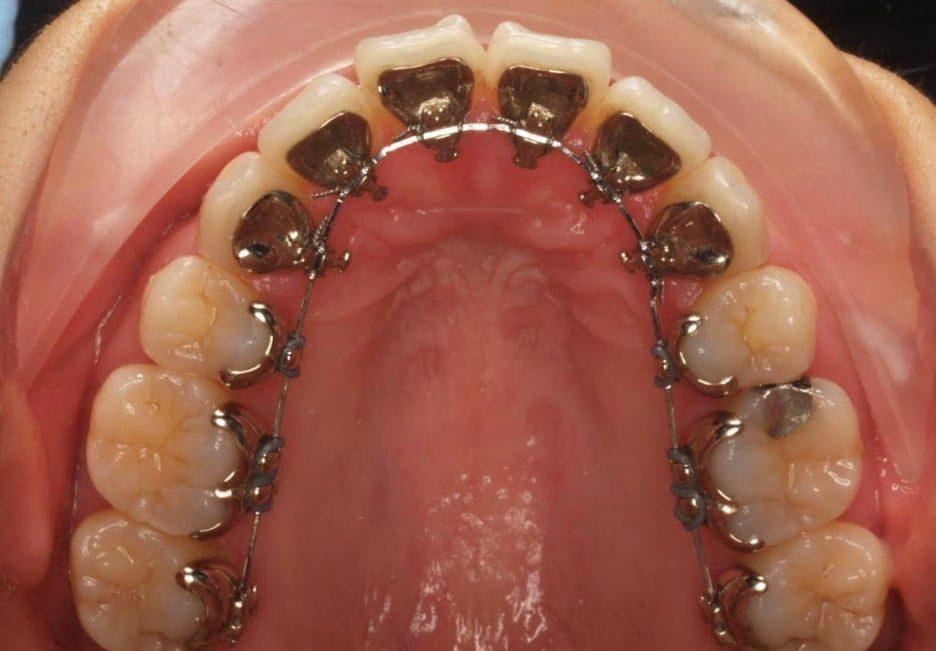
They are fixed braces with brackets attached to the inner surfaces of the teeth. The principle of moving teeth is the same as conventional braces attached to the outside; only the surface they're attached to is different. Since you don't put them in and take them out like clear aligners, there is less risk of the force being interrupted while they're out.
Instead, your tongue touches the appliance every day. The advantage of being invisible and the drawback of tongue discomfort come from the same place. That is why I don't choose lingual braces just because they can't be seen.
| Lingual braces tend to suit | Tend to suit less |
|---|---|
| Jobs or schedules where appliances must not be visible | Speech is central to your work, so an adjustment period is hard to allow |
| Hard to wear clear aligners for more than 20 hours a day | Hard to brush the inner side thoroughly |
| Worried about the force being interrupted while aligners are out | A deep bite, so the lower teeth easily hit the appliance |
How long does the speech effect of lingual braces last?
Most people adjust within 2–3 weeks, and for some it lingers for a month or two. Because the appliance sits on the inside of the front teeth where the tip of the tongue touches, sounds like s, sh, t, and d may whistle or feel awkward at first. In most cases this settles as the tongue learns where the appliance is.
- Avoid scheduling the bonding day in a month packed with presentations, calls, or lectures.
- If the side or tip of your tongue gets rubbed, covering the spot with orthodontic wax helps a lot.
- Reading aloud helps your tongue learn the new positions faster.
Why do lingual braces cost more?
Because the inner surfaces curve differently on each tooth and the field of view is narrow, so bonding and adjusting take more time. Smaller brackets have to be attached at precise angles in a narrow space where the tongue and saliva move around, and the upper and lower teeth can easily touch and hit the appliance. Each visit also takes longer than with outer braces.
However, the overall duration doesn't get longer just because of the type of appliance. The amount of movement, whether teeth are extracted, and the condition of the gums determine the duration. Comprehensive orthodontics for adults usually takes 1 year 6 months to 2 years 6 months.
How are lingual braces different from clear aligners?
Both are hard to see from the outside. The biggest difference is whether you take the appliance out.
| Point | Lingual braces | Clear aligners |
|---|---|---|
| Removable? | Stay attached | Taken out to eat and brush |
| When force is applied | Always | Only while worn (20–22 hours a day recommended) |
| Brushing | Hard, as the inner side is covered | Take them out and brush |
| Initial discomfort | Speech and a foreign-body feeling on the tongue | A tight feeling; less effect on speech |
| Difficult movements | Areas where the appliance interferes | Large rotations or when roots need to be uprighted a lot |
If it's hard to keep to the wearing time, I look at lingual braces; if being able to take them out to clean matters and you can keep to the wearing time, I look at clear aligners. I summarized how to choose clear aligners in How to choose clear aligners.
How we do it at Wonjin Dental
I ask first how you spend your day, rather than about the name of the appliance. The orthodontic options on Wonjin Dental's fee list are comprehensive orthodontics with self-ligating brackets (Clippy C), clear aligners (Seraphin), and partial orthodontics for the front teeth. Whether lingual braces are right for you, I'll tell you at the consultation after looking at both the direction your teeth need to move and your lifestyle. An orthodontic diagnosis is ₩100,000, and the cost for each appliance is in the full fee list.
I don't choose based on invisibility alone. For people whose tongue is sensitive or whose work centers on speaking, I don't insist on lingual braces, and if a movement can't be done, I tell you so.
Frequently asked questions
How do I brush during lingual braces treatment?
A regular toothbrush doesn't reach well around the inner appliance, so use an orthodontic toothbrush together with an interdental brush. These surfaces are hard to see in a mirror, so it's good to get into the habit of brushing in a set order from the start.
What if my lower front teeth touch the upper appliance?
For people with a deep bite, the lower front teeth can touch the appliance on the inside of the upper front teeth. In that case, I temporarily raise the height on the molar side so they don't touch.
Are there foods to avoid with lingual braces?
Avoid sticky foods like rice cakes and caramel, and hard nuts, as they can pull the brackets off. Cut foods that you'd take a big bite of with your front teeth into small pieces and chew them with your molars.
Do I need a retainer after lingual braces?
Yes. Regardless of where the appliance is, teeth that have been moved tend to move back, so after orthodontics a retainer holds them in place.