What is scissor bite?
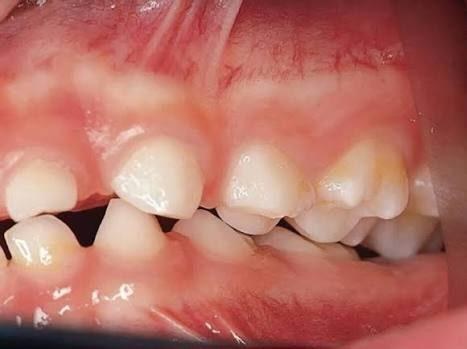
It's a condition in which the upper and lower molars slide past each other's sides like the blades of scissors. Normally, the chewing surfaces of the upper and lower molars overlap to crush food, but scissor bite is a type of malocclusion with a side-to-side mismatch, so the chewing surfaces don't meet properly. Many people come in saying, “My front teeth are fine, but I keep biting my cheek.”
There are also cases in the opposite direction. When the upper molars sit further toward the palate than the lower ones, it's called a posterior crossbite, and since the cause and treatment are different, I don't group them together.
Does it need treatment even without symptoms?
Not every scissor bite needs to be fixed right away, but I recommend getting a diagnosis.
- Teeth that don't meet gradually move further up or down over time (overeruption). Later, when an implant or restoration is placed, the height won't match
- If you develop a habit of chewing on only one side, the chewing muscles and jaw movement can become lopsided
- Chewing efficiency drops and the inside of the cheek gets bitten often
In particular, when a molar implant or crown is needed later, the opposing tooth that has already overerupted can make it hard to match the height. Even without symptoms, it's good to check regularly whether the tilting is progressing.
How is scissor bite treated?
The goal is to get the molar chewing surfaces overlapping again. The way force is applied differs depending on the tilt, the extent, and whether there is a skeletal problem.
| Method | When it's used |
|---|---|
| Cross elastics | When one or two teeth are slightly tilted. Buttons are attached on the palate side of the upper molar and the cheek side of the lower molar, and the elastic is hooked between them |
| Transpalatal arch | When controlling the rotation and tilt of the upper molars on both sides together |
| Mini-screw | When elastics alone would pull other teeth along or cause overeruption |
| Bite raising | When the upper and lower teeth collide and block the desired movement; they're temporarily separated with composite resin |
Elastics need to be worn for the set time. If you leave them out, the tilted teeth try to go back. Bite raising isn't used in every case; it's added as a supplement only when there is interference. I explained why mini-screws are needed in Orthodontic mini-screws.
When is partial orthodontics possible?
| What to check | Partial orthodontics | Consider full orthodontics or surgery |
|---|---|---|
| Number of misaligned teeth | One or two | Several molars |
| Left-right width of the jaws | Matches | Large difference between upper and lower widths |
| Facial asymmetry | Not significant | Skeletal asymmetry |
| Overall alignment | Generally even | The whole dentition is off |
During the growth period, jaw growth is assessed as well, and in adults, if the skeletal difference is large, surgery is sometimes considered. If only the front teeth are straightened and the molars are left as they are, the chewing surfaces will keep sliding past each other. You can see the scope of partial orthodontics on the partial orthodontics page.
How we do it at Wonjin Dental
I don't skip over the molars just because the front teeth are straight. Even if only one side is off, I don't leave it; I check the cause first. I look together at whether the molar chewing surfaces meet each other, whether teeth are overerupting, and whether there is an effect on the gums and future restorations. I consider partial orthodontics only when it's limited to one or two teeth and the jaw widths match. MTA partial orthodontics is ₩1,800,000 and an orthodontic screw is ₩100,000 (as of September 2026); detailed costs are in the full fee list.
Frequently asked questions
How long does partial orthodontics for scissor bite take?
It depends on the amount of movement and the tilt, but when it's limited to one or two teeth, it's often finished within a matter of months. If there is also overeruption, it can take longer.
Can scissor bite cause jaw joint pain?
If the habit of chewing on one side continues for a long time, it can put a strain on the jaw muscles and joint. However, jaw joint symptoms have many causes, so I don't conclude it's the bite alone.
Can wisdom teeth cause scissor bite?
Sometimes a wisdom tooth comes in tilted and pushes the neighboring molar out of line. In that case, I consider extracting the wisdom tooth first.
Can scissor bite be treated with clear aligners?
In mild cases, it's sometimes attempted with clear aligners plus elastics or auxiliary appliances. If the tilt is large or there is also overeruption, brackets and mini-screws are often more reliable.