What kind of treatment is an inlay?
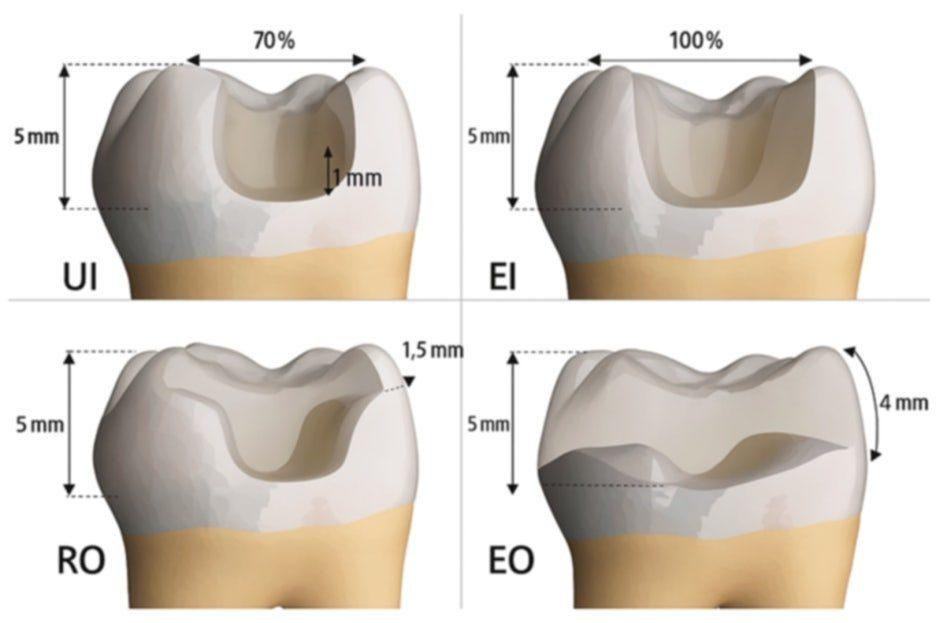
An inlay is a treatment where, after the decay is removed, an impression or scan of the area is taken, and a piece made outside the mouth is fitted and bonded in place. Unlike a composite filling, where the material is built up and hardened directly in the mouth, it is called an indirect restoration. It is mainly done on molars when the decay extends widely across the chewing surface and the surfaces touching the neighboring teeth.
Because it is made outside the mouth, it is easier to make the shape and the contact with neighboring teeth precise. In exchange, there is time needed for the impression and fabrication, so it usually takes two visits.
- Visit 1: The decay is removed, an impression or scan is taken, and the tooth is temporarily sealed.
- Fabrication: The inlay is made outside the mouth.
- Visit 2: It is tried in, the bite is checked, and it is bonded.
How do composite fillings, inlays, and crowns differ?
The difference between the three treatments is how much of the tooth they cover. A composite filling fills a small hole, an inlay fills a wide space, and a crown wraps the whole tooth.
| Category | Composite filling | Inlay | Crown |
|---|---|---|---|
| Where it is made | Directly in the mouth | Outside the mouth | Outside the mouth |
| Suitable cavity | Small holes, narrow side surfaces | Wide chewing and side surfaces | Almost no walls left, after root canal treatment |
| Amount trimmed | The least | Moderate | The most (trimmed all around) |
| Visits | Usually 1 | Usually 2 | Usually 2 or more |
| Weakness | Shrinks slightly as it hardens, weak against strong forces | Rarely breaks or comes off | A lot of tooth is trimmed |
Composite resin shrinks slightly as it hardens under light, and if bacteria get into that gap, secondary decay can form. An inlay is made outside the mouth and then bonded, so this shrinkage is less of a concern. For people who grind their teeth or have a strong bite, we consider an inlay even for small holes.
How much does an inlay cost?
These are the prices for inlays and comparable treatments at Wonjin Dental (as of September 2026, per tooth).
| Treatment | Price |
|---|---|
| Composite filling, premolar | ₩100,000 |
| Composite filling, molar | ₩150,000 |
| Composite filling, between teeth (proximal surface) | ₩300,000 |
| Resin inlay | ₩300,000 |
| Ceramic inlay | ₩350,000 |
| Back tooth PFM crown | ₩400,000 |
| Back tooth zirconia crown | ₩500,000 |
| Back tooth gold crown | ₩800,000 |
All prices can be found on All treatment fees. A more expensive material does not mean it is the right material for that hole.
How do you choose between a gold inlay and a ceramic inlay?
Neither is always better; we choose by looking at the weak points of that spot. Gold wears similarly to natural teeth and rarely breaks, but its color stands out. Ceramic is close to tooth color and stains less, but it can rarely break. We also consider whether the molar shows when you smile and how strong your bite is.
We look at the opposing tooth too. If a hard material is left rough, it can wear down the opposing natural tooth more, so with ceramic inlays, polishing the surface smooth after bonding is an important step.
Can a tooth that has had root canal treatment get an inlay?
In most cases, it is covered with a crown. This is because a tooth that has had root canal treatment is hollow inside and easily splits under chewing forces. Only in rare cases where enough wall remains do we use an inlay. Crown materials are summarized in Crowns: how to choose between all-ceramic and zirconia.
How we do it at Wonjin Dental
Rather than the name of the material, I first look at whether the remaining tooth wall can withstand chewing forces. If it can hold up with less trimming, we do not cover it, and if there is almost no wall, we do not just fill the space and send you off.
- Narrow hole: finished the same day with a composite filling
- Wide and extending to the side surfaces: inlay
- Almost no wall, or not enough wall after root canal treatment: crown
We do not trim all around a tooth that does not yet need covering, and we do not insist on composite resin for a hole that composite resin cannot hold up in.
Frequently asked questions
How long does an inlay last?
It depends on care and biting habits, but it usually lasts many years. Secondary decay at the edges and teeth grinding are the main causes that shorten its lifespan.
If an inlay comes out, can it be bonded again?
If the piece is not broken and there is no decay underneath, it can be bonded again. Don’t throw away the piece that came out; bring it with you.
Is sensitivity after an inlay normal?
After bonding, it may be sensitive to cold for a few days to a few weeks, and in most cases this decreases. If the sensitivity gets worse or it hurts even at rest, it may be a nerve-related problem and needs to be checked.