Why is redoing porcelain veneers harder than the first time?
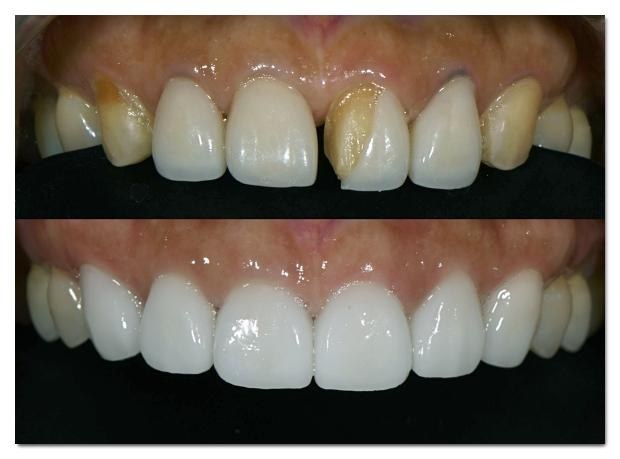
“My old one broke. I just get a new one put on and that’s it, right?” I often hear this in consultations about redoing veneers. But redoing them calls for more care than the first time. There are two reasons.
- The process of removing the existing porcelain can itself wear away more of the tooth.
- If you don’t know why the problem happened, the same failure repeats.
How are porcelain veneers removed?
Porcelain is firmly bonded to the tooth, so it is usually removed by grinding. At this point, the boundary between the porcelain and the tooth is hard to tell apart by eye, so enamel is easily ground away along with it. There is also a method of weakening the bonding layer with a laser to remove it, but whether it applies depends on the type of ceramic, its thickness and its position.
If a tooth was ground down a lot the first time, the remaining walls shrink further when redoing, making it hard to place a veneer again. In that case, it sometimes moves to a front tooth crown that wraps around the tooth. In a consultation, rather than how many to redo, I first look at how much wall will remain after removal.
What causes should be checked before redoing veneers?
| Symptom | Cause we look at first |
|---|---|
| Margins turning yellow | Bonding condition and material, gaps at the margin |
| Lifting or repeatedly falling off | Bonding or bite |
| Only the same corner chips | Force concentrated in one spot, teeth grinding |
| Sensitivity | Exposed dentin, decay under the margin |
| Gums swollen and bleeding | The margin pressing on the gum, a ledge |
If a new one is put on while the cause is left as is, the same failure comes. Redoing veneers is closer to finding and correcting the cause than to attaching a new restoration. We check whether decay has gone under the margin, whether there is a crack, and whether one tooth touches first, and only after adjusting the bite do we decide whether to reattach or make a new one. If the order changes, the result changes too.
When should porcelain veneers be replaced?
There is no fixed number of years. We check them when you see the signs below.
- The margins turn yellow or the line becomes visible
- A slight lifting feeling, or a gap your tongue catches on
- A crack or a chipped corner
- Sensitivity that wasn’t there before
Even without discomfort, if bacteria get in through a lifted gap, decay can progress inside while the outside looks fine. Removing them later leaves even fewer options, so it is safer to have them checked regularly. If only the color has changed, see the article on discolored porcelain veneers.
To make them last after placement, it helps not to bite hard things with your front teeth, to wear a night guard if you grind your teeth, and to make a habit of cleaning the margins with floss.
How we do it at Wonjin Dental
In a consultation, the order in which I answer is: why it happened, how it will be removed, how much wall will remain after removal, and whether there is a way to place a veneer again without wrapping the tooth. If a veneer can be placed again without grinding, I talk about Brinate. If the teeth protrude or there is a skeletal protruding mouth, we don’t place it again. If something can’t be done, we say so.
| When redoing | Cost |
|---|---|
| Brinate Basic / Build-up / Platinum (per tooth) | ₩330,000 / ₩550,000 / ₩990,000 |
| Anterior ceramic crown / zirconia crown | ₩800,000 / ₩700,000 |
As of September 2026; cosmetic treatments include VAT. The full list of items is in all fees.
Frequently asked questions
Can porcelain veneers done at another clinic be redone?
Yes. Knowing the material or treatment records from that time helps decide how to remove them.
How long does redoing veneers take?
First there is a day to remove them and check the cause, and then the time to make new ones is added. For Brinate, Basic is same day, Build-up about 1 week, and Platinum about 2 weeks; if it moves to a crown, the timeline differs.
Does removal hurt?
If the veneer was bonded on enamel, there is often not much sensitivity. Teeth that were ground into the dentin the first time can be sensitive, so the work is sometimes done under anesthesia.
Can I switch to no-prep when redoing?
If enamel remains after removal and the teeth don’t protrude, it can be redone with a method placed without grinding. If a wide area of dentin is already exposed, wrapping the tooth lasts longer than placing a layer on top.