How many visits does a root canal usually take?
Root canal treatment usually finishes its main stage in 2–4 visits, each taking about 30 minutes to an hour. It is the question I hear most often in the treatment room, but I do not promise a number of visits in advance. If the canals are short and straight, you come fewer times; if they are narrow and curved or infection remains, you come more.
The precise name for a nerve treatment is root canal treatment (endodontic treatment). When the pulp inside the tooth (the tissue containing blood vessels and nerves) becomes inflamed or infected from deep decay, a crack, or trauma, this treatment removes that tissue, cleans and disinfects the canals inside the root, and then seals them.
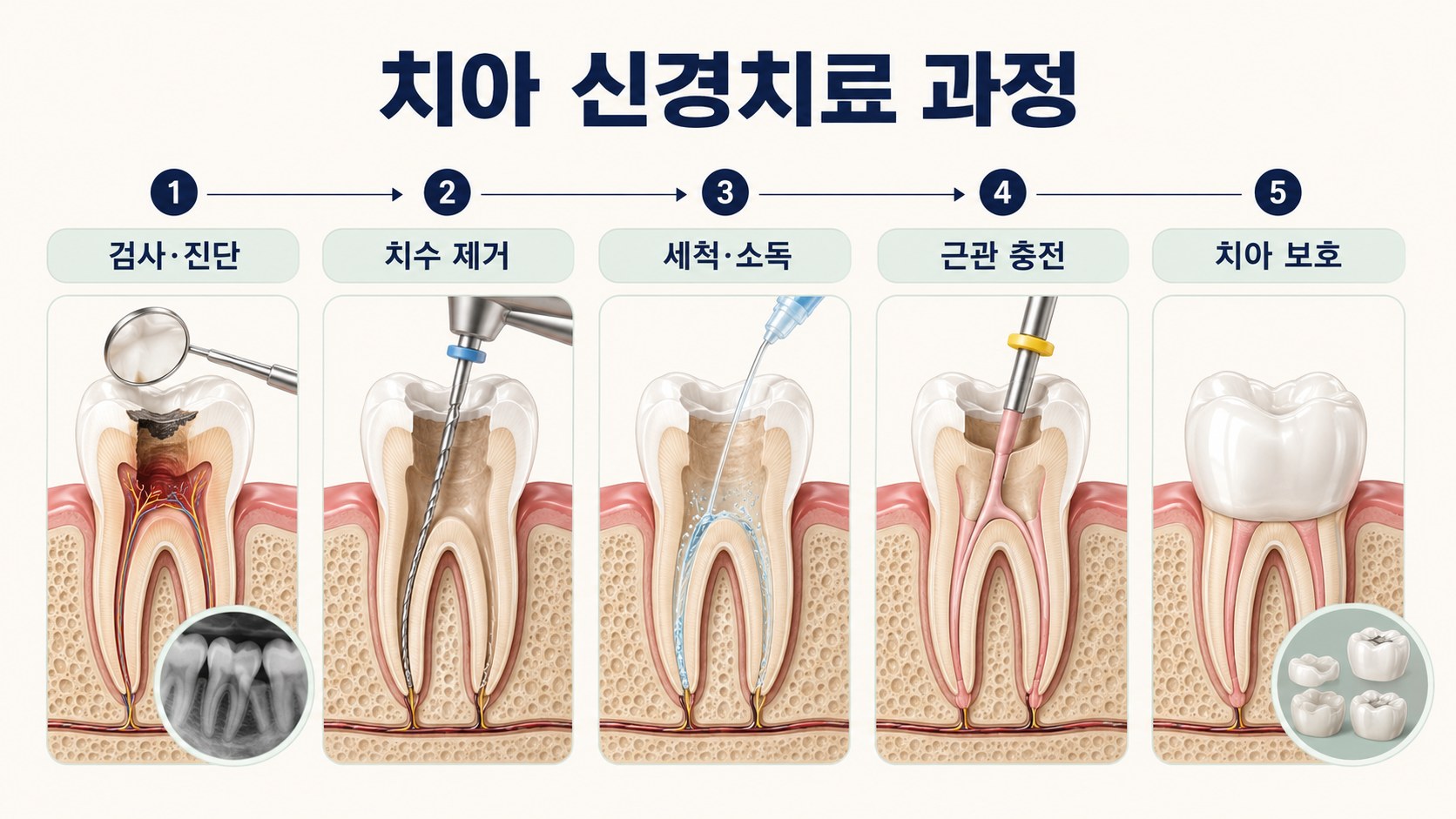
What are the steps of a root canal?
Root canal treatment proceeds in four stages: diagnosis, cleaning the canals, filling the canals, and the final restoration. The common flow is shown below.
| Stage | What is done | Usual visits |
|---|---|---|
| 1. Diagnosis, anesthesia, opening | We check symptoms and X-rays to see whether the pulp can be saved; if not, we clear the decay and infected area and enter the pulp | 1st visit |
| 2. Shaping, irrigating, disinfecting the canals | We measure the canal length, shape the canals, rinse them, and disinfect them. Medication is placed between visits and the tooth is temporarily sealed | 1–2 visits, more depending on the canals |
| 3. Filling the canals | The cleaned canals are filled with material and sealed | Final visit |
| 4. Final restoration | The tooth is filled with composite or an inlay, or covered with a crown | 1–2 separate visits |
If there is a chance to keep the pulp, we look at keeping it first. Many teeth still need a crown or other covering after the main stage is done, so I explain the whole schedule at the start.
Why does the number of root canal visits differ from person to person?
Because the shape of the canals and the depth of the infection differ from tooth to tooth. Front teeth often have one canal, while molars commonly have three or more. If the canals are very narrow or curved, shaping and rinsing them takes more time.
Narrow, curved canals that are missed during the first treatment become a reason the tooth has to be retreated later. That is why some teeth are sealed after one round of disinfection, while others get extra days to reopen and clean the canals. Don’t measure yourself against someone else who finished in two visits. I seal the canals not on a particular visit number but on the day they are clean.
| Canal condition | Common course |
|---|---|
| Short, straight, little infection | Sealed in fewer visits |
| Narrow and curved, or infection remains | Extra days for rinsing and disinfecting |
| Retreating a tooth that had a root canal before | Starts by removing the old filling material, so the number of visits tends to increase |
How I decide when a tooth that already had root canal treatment hurts again is covered separately in root inflammation: when the tooth can be saved without extraction.
What happens if you stop a root canal partway?
You should not stop partway just because the pain is gone. A tooth under treatment is sealed with temporary material, so if bacteria get back in through a gap, the inflammation grows and the tooth may eventually have to be pulled.
A temporarily sealed tooth is weak and breaks easily. Until the final restoration, chew on the other side and avoid hard or sticky foods. If the temporary material comes out, don’t wait for your next appointment; contact us.
Do I always need a crown after a root canal?
Molars and premolars are often crowned, while front teeth can sometimes be finished with a filling if enough tooth wall remains. Teeth that need root canal treatment often already have thin walls from large decay or damage, and teeth in spots with strong chewing force crack more easily.
I do not decide on a crown just because a root canal was done. I decide based on the position, the remaining tooth structure, any cracks, and the chewing force. You can compare crown materials in the zirconia crown guide.
How we do it at Wonjin Dental
Before starting treatment, I explain three things first: whether the tooth really needs root canal treatment, how much infection is in the canals now, and how we will protect the tooth after sealing it. Root canal treatment itself is covered by insurance (Korean National Health Insurance).
The goal is not to remove the nerve. It is to remove the infected tissue, clean and seal the canals, and, if possible, keep your natural tooth.
Frequently asked questions
Does a root canal hurt a lot?
It is done under anesthesia, so there is usually little pain during treatment. For 2–3 days after the anesthesia wears off, the tooth may throb when you chew, and this gradually eases. If swelling grows or the pain gets stronger, contact us.
How long does a root-canal-treated tooth last?
There is no fixed lifespan. It depends on how well the canals are sealed, whether the restoration fits without gaps, and whether there are forces such as teeth grinding. If the final restoration is put off for a long time, the tooth often cracks or gets reinfected.
Why does a front tooth turn dark after a root canal?
After the pulp is gone, the tooth can darken to gray or brown over time. For a front tooth, we can first consider internal whitening, which brightens the root-canal-treated tooth from the inside.