Do I really need orthodontics for a snaggletooth?
Whether a snaggletooth needs orthodontics is decided by cleaning and function rather than appearance. “Does the snaggletooth have to be pulled? I heard orthodontics means having teeth removed.” I hear this often in the treatment room. Even if the teeth overlap a little, if there is no problem cleaning or chewing, we monitor it.
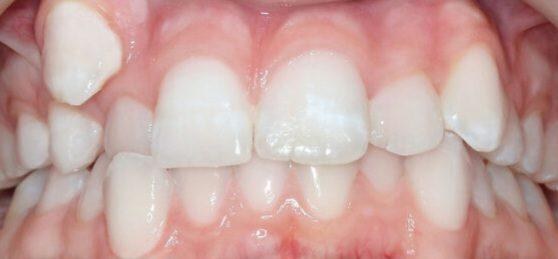
On the other hand, even if function is fine, if you find yourself covering your mouth every time you smile, I don’t take that feeling lightly. Whether to treat is first the patient’s decision, and I explain accurately what range of treatment is needed and what its limits are.
When is orthodontics recommended for a snaggletooth?
If any one of the following applies, I recommend treatment even if it is not for cosmetic reasons.
- Toothbrush bristles and floss cannot get into the overlapping surfaces, so cavities or gum inflammation keep recurring
- Teeth wear down from premature contact, where a particular tooth hits first
- There is also a crossbite (upper and lower teeth biting in reverse) or a deep bite
- The gums on the snaggletooth side have started to recede
- Not just one canine, but the front teeth and lips also stick forward, or the jaw is asymmetrical
Overlaps that cannot be cleaned because of their structure are not easily solved by brushing effort alone. If there is already gum inflammation, we first calm it with gum treatment before starting orthodontics.
Do teeth always have to be extracted to correct a snaggletooth?
Extraction is not the default when correcting a snaggletooth. Just as books stick out when forced onto a narrow shelf, when the total width of the teeth is larger than the arch the jaw provides, the teeth get pushed out. How much space is missing decides on extraction.
We consider extraction when crowding (teeth bunched in layers) is large so space is greatly lacking, when the front teeth and lips already stick forward a lot, and when moving the teeth further outward would take them outside the jawbone. Even then, we look at a premolar before the protruding canine. The canine has a long root and guides the bite when you chew sideways, so we keep it unless it has deep decay or is impacted with a poor outlook. The criteria for extraction are covered separately in why teeth are extracted for orthodontics.
How can space be made without extraction?
| How space is made | When it is used |
|---|---|
| Interproximal reduction (thinly reshaping the enamel where teeth touch) | When front teeth overlap and the teeth are wide |
| Arch expansion | When the upper or lower arch is actually narrow |
| Uprighting the front teeth | When the front teeth are tilted inward |
| Rotating or uprighting molars | When rotated or tipped molars take up length |
| Moving molars back | When the upper molars sit forward and space at the front is lacking |
| Extraction | When crowding is large, the mouth already sticks forward, or pushing outward would take teeth outside the bone |
If non-extraction is forced, teeth move outside the alveolar bone and the gums recede. Not extracting is not always the way to protect the teeth, so if something cannot be done, I tell you so.
How we do it at Wonjin Dental
I don’t suggest pulling teeth based on a single photo of a canine. I look together at how much space is missing, where the lips are, and the limits within which the teeth and alveolar bone can hold up; if all three fit, I make room without extraction, and if not, I recommend extraction. When only the snaggletooth needs to move, we narrow the scope with partial orthodontics. Having a snaggletooth does not make orthodontics mandatory, and even when orthodontics is needed, extraction is not the default.
Frequently asked questions
If I leave a snaggletooth alone, will it get worse later?
In adults it rarely changes much on its own, but if bone is lost from gum inflammation or neighboring teeth tip into the space of a missing tooth, the overlap can increase. We check for changes at regular checkups.
How long does snaggletooth orthodontics take?
Partial orthodontics to move just the snaggletooth usually takes 6 months to 1 year, and moving the whole arch takes around 1.5 to 2.5 years. It depends on whether teeth are extracted and how far they need to move.
Does extraction orthodontics change your face a lot?
How it looks depends on how much of the extraction space is used to move the front teeth back and where your lips originally sit. I don’t claim the face will change dramatically; we decide on the mouth profile you want together at the diagnosis.
Do I still get scaling during snaggletooth orthodontics?
Yes, it is better to. Tartar builds up easily around appliances, so even during orthodontics I recommend scaling and gum checks every 3–6 months.