What is the difference between a craze line and a crack in a tooth?
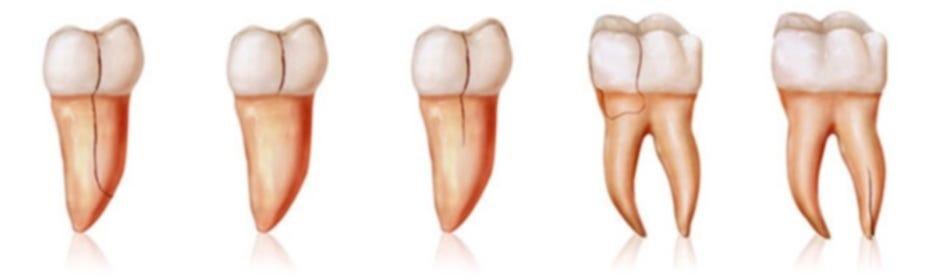
A craze line is a line on the surface; a crack is a fracture that progresses into the tooth. A craze line is a fine line on the surface of the enamel (the outermost layer of the tooth); it does not hurt and appears with age or after an impact. A crack can progress past the dentin toward the nerve (pulp) and root, so it hurts, and the tooth can split.
| Type | Depth | Symptoms | Treatment |
|---|---|---|---|
| Craze line | Enamel surface | None | Watch |
| Stained craze line | Enamel surface | Line is noticeable | Polishing, composite resin, porcelain veneers |
| Crack | Into the dentin | Sharp zing when chewing or releasing the bite | Reinforcement or a crown, depending on depth |
| Vertical root fracture | Down to the root | Swollen gums, bone loss | Extraction |
Can I just leave a cracked tooth alone?
If it is a craze line that does not hurt, you can watch it. The tooth's function is not broken, and many people use such teeth for a long time without treatment. On front teeth, the line sometimes becomes noticeable because stain soaks into it, but that is stain, not a sign that the tooth is in trouble.
However, if a cavity has formed at the crack or it hurts even occasionally, I do not put it off. A tooth does not knit back together, and waiting will not fill in the line.
What causes cracks in front teeth?
They usually come from several forces combined. Fine lines that form in the enamel with age are common and mostly not a problem, but if the causes below are repeated, the lines can deepen.
- Trauma from falling or being hit
- Teeth grinding or clenching
- A habit of biting hard things with the front teeth (ice, nuts, bottle caps)
- Temperature changes when alternating hot and cold foods
- Teeth with large fillings or root canal treatment
What symptoms tell you it is a crack?
Rather than aching all day, the typical sign is a momentary sharp zing when you chew in a certain direction or when you release the pressure while chewing. Since you do not always chew food in the same direction, the pain comes and goes too. So “it only hurts sometimes” does not mean it is fine.
It may be sensitive to cold at first, and later it may hurt even when you are doing nothing. This can be a sign that the inflammation has reached the nerve.
How does treatment differ by the depth of the crack?
- Shallow, stained craze lines: we polish the surface so they are less visible. Very little is removed.
- When you want to cover the line, color, and shape together: we consider front-tooth composite resin or porcelain veneers.
- A crack with a slightly chipped edge: we reinforce the wall with composite resin or porcelain veneers.
- A dentin crack that hurts when chewing: filling just part of it may not stop the line, so we cover it with a front-tooth crown.
- A vertical split down to the root: we extract the tooth before the bone next to it dissolves.
Getting a crown does not necessarily mean root canal treatment is done as well. It is done together only when the nerve has become inflamed (pulpitis); I have summarized the process in How many visits does root canal treatment take?
How we do it at Wonjin Dental
I first ask in which direction it hurts when you chew. Then, only after classifying the depth of the line with magnification and light, a bite test, and X-rays, do I tell you whether to watch it, reinforce it, or extract it. We do not drill a craze line as if it were a crack, and we do not leave a painful crack as if it were a craze line.
Cracks in front teeth are a problem where overtreatment and neglect both occur. We do not force a tooth split down to the root to stay and cause loss of the neighboring bone. After treating a cracked tooth, if there is a habit of grinding or biting things off with the front teeth, I also explain ways to manage it.
Frequently asked questions
Does whitening erase craze lines?
The line itself is not erased. As the whole tooth gets brighter, the stain in the line may be less visible, but it can also remain like a blotch.
Are cracks in front teeth related to teeth grinding?
Yes. Grinding, clenching, and the habit of biting hard things with the front teeth make cracks deeper. If the habit remains after treatment, the tooth can crack again.
Do teeth with root canal treatment split more easily?
Yes. A tooth that has had root canal treatment is hollow inside, so it more often splits vertically down to the root. That is why teeth that bear force are often covered with a crown.