Are there other causes of molar pain besides cavities?
Yes. Sensitivity to cold water feels similar with early cavities and cracked teeth, and throbbing when chewing overlaps between cracks and gum disease. In the treatment room I often hear, “It only hurts when I chew; can I wait and watch a bit longer?” But it is hard to pin down the cause from symptoms alone.
| Cause | Common sensation |
|---|---|
| Cavity (tooth decay) | Sensitive to cold and sweet things; as it progresses, pain when chewing |
| Cracked tooth | Sharp zing when chewing in a certain direction; pain the moment you release |
| Gum disease | Gums swell and bleed, with a dull throbbing |
| Pulpitis | Hurts even at rest and gets worse at night |
| Wisdom tooth | The gum at the very back swells, and the pain reaches the neighboring molar |
What signs tell you a molar has a cavity?
Early cavities in molars are often hard to feel yourself, so we treat small changes like the following as signs.
- Brief sensitivity when drinking cold water
- A moment of pain when eating something sweet
- Discomfort when chewing on a particular spot
- A spot where food gets stuck unusually often
- The surface looks dark, or a small hole is visible
Not everyone gets the same signs, and the pain may come briefly and then go away. You cannot feel reassured just because there are no signs. Cavities between molars in particular are not visible from the outside and are often found with X-rays.
Can you tell the stage of a cavity from the pattern of pain?
To some extent. The deeper the cavity, the longer the pain lasts, and it starts to hurt even without a trigger.
| Progress | Pain | Usual treatment |
|---|---|---|
| Enamel (outer layer) | Almost none | Fluoride application and monitoring; composite filling if a hole forms |
| Dentin | Sensitive when chewing or to sweets | Composite filling or inlay |
| Near the nerve | Sharp pain with cold that fades once the trigger stops | Inlay or crown |
| Into the nerve (pulp) | Hurts even at rest, and at night | Root canal treatment followed by a crown |
The actual treatment is decided by how much tooth structure remains. Even if decay has reached the dentin, a small area may be finished with a composite filling, and even near the nerve, an inlay may be enough if the walls are sufficient. I have explained the differences by stage in detail in the Cavity stages article.
It hurt for a moment and then felt fine. Can I leave it?
It is better not to. Early cavities and cracked teeth repeatedly come and go in pain, and they keep progressing in between. If it has started to hurt even at rest, the nerve may already be affected, and root canal treatment may be needed.
Many people tell me in the treatment room, “I didn’t know I had a cavity.” Small changes such as brief sensitivity, a throb felt only when chewing, or the discomfort of food getting stuck can be signals your teeth are sending.
How we do it at Wonjin Dental
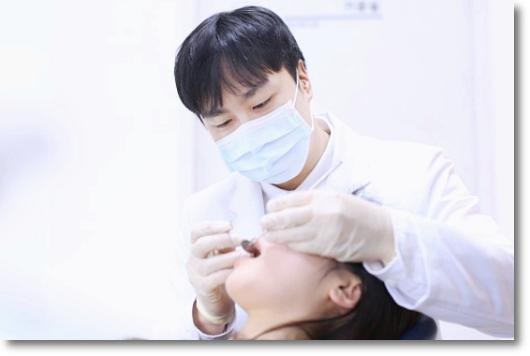
I first use an examination, an explorer, and X-rays to tell whether the cause is a cavity, or a crack, the gums, or a wisdom tooth. For a narrow cavity, I clean out only the damaged part and fill it with composite filling; if it is wide, I recommend an inlay, and if more than half the tooth needs to be covered, a crown. I do not dismiss even brief sensitivity as a small thing.
Even after treatment, if plaque builds up around it, the same tooth will decay again. Molars have many grooves, so please use floss and interdental brushes too, and I recommend a check-up every 3 to 6 months even if you have no discomfort.
Frequently asked questions
Can I take painkillers when my molar hurts?
They can reduce the pain temporarily, but they do not treat the cause. Even if medicine calms it down, the problem can keep progressing, so please get checked as soon as possible.
How much does a composite filling on a molar cost?
At Wonjin Dental, a composite filling on a premolar is ₩100,000, and on a molar it is ₩150,000 (as of September 2026). The price differs if the filling must extend between the teeth.
Can molar pain spread to my ear or head?
Molar pain can feel as if it spreads to the ear, temple, or jaw. When it is hard to pinpoint which tooth hurts, more examination is needed.
How can I prevent cavities in my molars?
The deep grooves on the chewing surfaces of molars can be sealed with sealants, and the spaces between teeth must be cleaned with floss and interdental brushes. Reducing how often you have snacks and sugary drinks also helps.