Why does it hurt and feel sensitive after gum treatment?
Because gum treatment works deeper than scaling, which only cleans the tooth surface. We remove tartar lodged inside the pocket between tooth and gum and, if needed, also do root planing, which smooths the root surface. “It’s throbbing now that the anesthesia has worn off. That’s okay, right?” is the message we get most often the next day.
During this process, the inflamed gum is irritated, and the root that had been hidden under tartar is exposed, so it becomes sensitive to cold. We do not see that sensitivity as a sign that something went wrong with the treatment.
The more severe the inflammation was before treatment, the more discomfort people tend to feel right after. On the other hand, as the swelling goes down, many people notice after a few days that there is less bleeding when brushing and that the gums feel firmer. Recovery speed differs from person to person, so rather than comparing yourself with others, look at whether your own symptoms are heading toward less.
How many days does pain after gum treatment last?
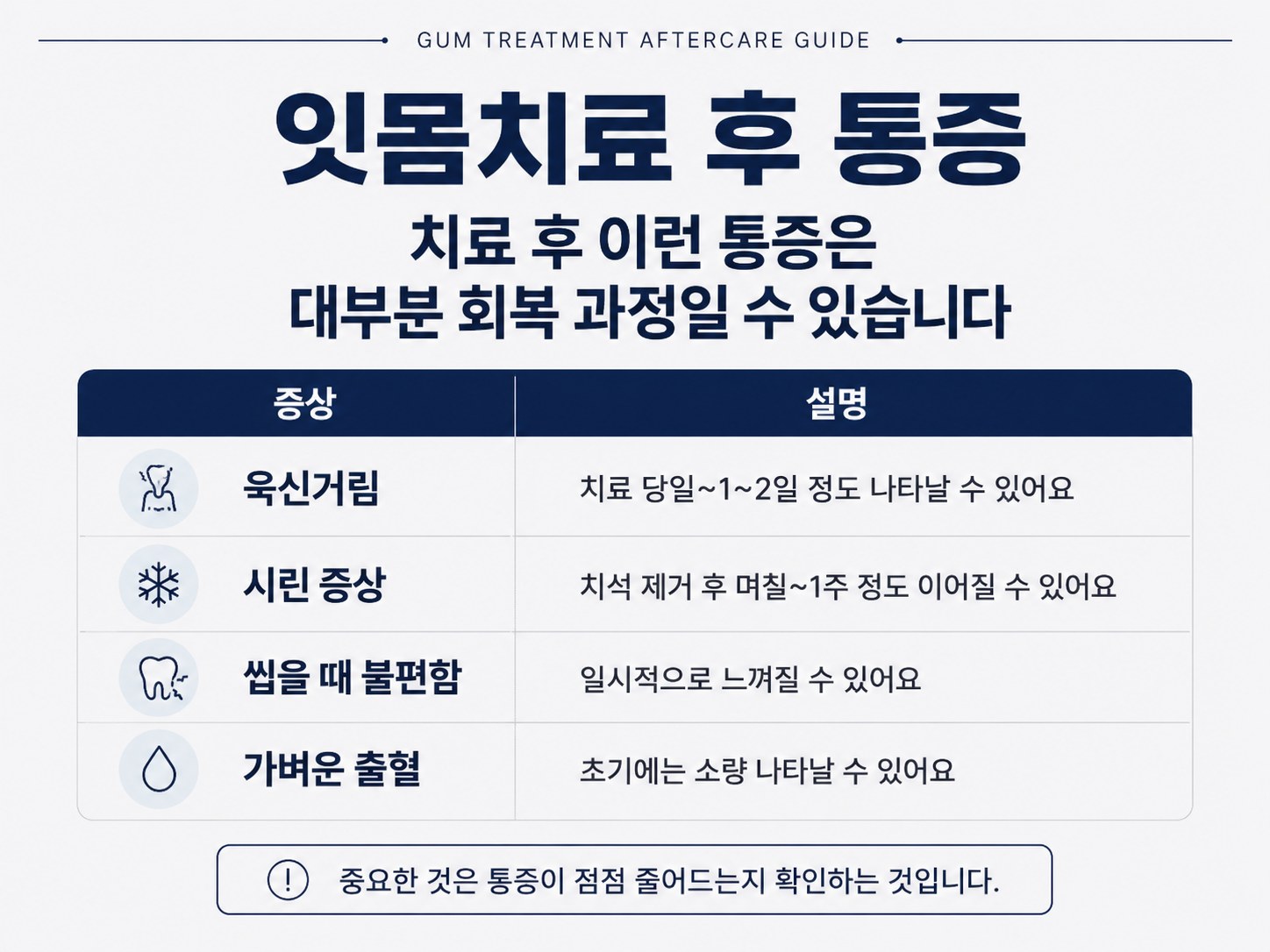
Mild throbbing usually weakens within 1–3 days, and sensitivity can last from a few days to over a week. How long it lasts depends on how deep the tartar was, how widespread the inflammation was, and how large an area was treated at once.
| Symptom | When it is okay to watch | When you should come back |
|---|---|---|
| Throbbing | Weakens after 1–3 days | Gets stronger over time |
| Sensitivity | Subsides over several days | Strong sensitivity continues, or lingers after the trigger is gone |
| Discomfort when chewing | A broad dull feeling across several teeth | Only one tooth hurts badly |
| Bleeding and swelling | Light bleeding, mild swelling | Large swelling, or pus appears |
We do not consider it a problem just because it hurts the next day. The most important measure is not whether there is pain, but whether it decreases over time.
Come back to the clinic in these cases
- When the pain actually gets stronger even after 2–3 days
- When the throbbing is severe even after taking painkillers
- When the gum swells up a lot on one side or pus appears
- When just one tooth hurts noticeably when chewing, or pain remains even without anything cold touching it
In the last case, the cause may be that tooth itself rather than the gums. It helps us find the cause if you tell us whether it hurts even at rest or only when chewing.
How should I brush and eat after gum treatment?
Do not stop brushing; brush gently with a soft-bristled toothbrush. If you skip that area because it hurts, plaque builds up again and the inflammation repeats. Avoid foods that are very hot, cold, or hard for a few days, and use any prescribed medicine and mouthwash as instructed. Smoking slows gum healing, so please refrain. While sensitivity is strong, toothpaste for sensitive teeth can help reduce discomfort.
How we do it at Wonjin Dental
Gum treatment such as scaling, root planing, and periodontal curettage is provided as a national health insurance item. When you report discomfort after treatment, we first look at the location and sort out whether it hurts at rest or only the moment you chew, and whether there is swelling or bleeding. Care is not over just because the pain has gone, so we decide together on the interval for your next check-up.
Frequently asked questions
How many sessions is gum treatment split into?
If the area is large, the mouth is often divided into two or three sections and treated over several visits. Treating a smaller area at a time also means less discomfort afterward.
My teeth look longer after gum treatment. Have my gums receded?
As swollen gums settle, the teeth often look longer or the spaces between them show. This is the result of the inflammation going down, and what you see is the gum line that had already receded. I have written more in Receding gums.
Can I brush if there is bleeding?
For light bleeding, you can brush gently and keep an eye on it. If you keep spitting because the blood bothers you, the pressure in your mouth can make the bleeding last longer. If there is a lot of bleeding and it does not stop easily, please contact us.
How do I keep things from getting worse again after gum treatment?
Tartar builds up again even after treatment. The most important things are to clean between the teeth every day with floss and interdental brushes, and to keep up check-ups and scaling at the intervals you are given.