Why don't receded gums grow back?
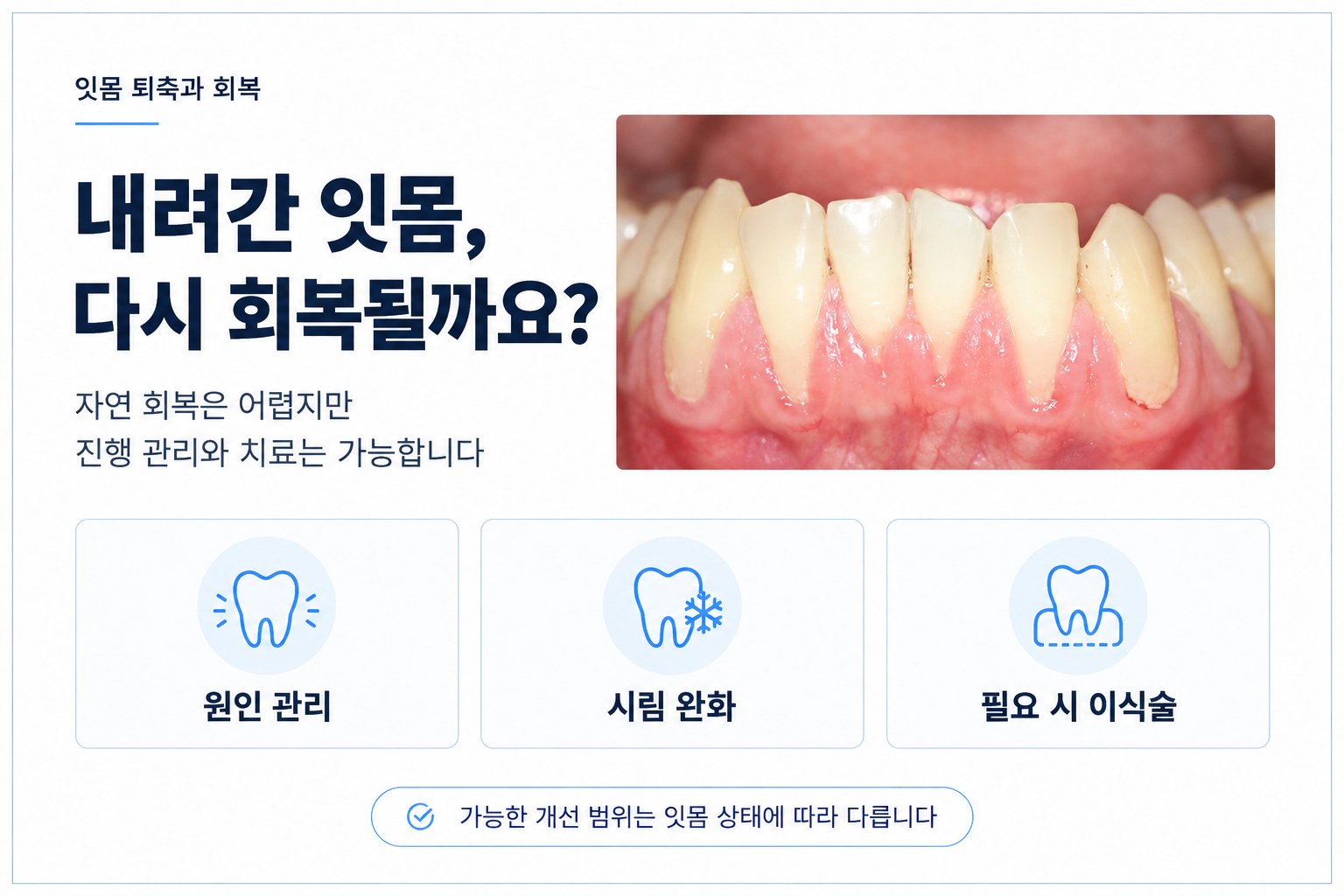
Because gum tissue that has moved down toward the root does not grow back to its previous height on its own. “It looks like my root is showing. Won't the gum fill back in?” Many people ask this when their teeth look longer in the mirror and feel sensitive to cold water. Teeth usually look longer because the gum line has moved toward the root.
Many people put their hopes in sensitivity toothpaste or scaling, but both only reduce discomfort and inflammation; they don't regrow lost gum tissue. Treating gum recession is not about reversing it, but about stopping it and protecting the tooth.
What causes gums to recede?
There may be one cause, or several overlapping ones.
- Periodontitis: as bacteria in plaque and tartar break down the gums and the alveolar bone (the bone supporting the teeth), the gum line goes down with them.
- Hard side-to-side brushing: pressing hard horizontally to clean thoroughly wears the gums away.
- Naturally thin gums, or teeth positioned toward the outside: because the bone and gums are thin, they recede easily even with small irritation.
- Tooth movement during orthodontics: when a tooth is pushed outside the bone, the gum can recede with it, so I look at the movement and the gums together.
Bleeding does not always mean the problem has reached the bone. I first distinguish gingivitis, which is limited to the gums, from periodontitis, which has reached the bone.
Is every sensitive tooth caused by gum recession?
No. When a root is exposed, it becomes sensitive to cold water and the toothbrush, but cavities and cracked teeth are also sensitive. A wedge-shaped notch at the neck of the tooth (cervical abrasion) is also different from receded gums, though the two can occur together. Treatment only fits when I distinguish areas where the nerve is exposed, where the root is exposed, and where the surface is notched.
How is receding gum treatment divided?
Depending on the condition, it is divided into sensitivity treatment, treating the cause, protecting the surface, and grafting.
| Condition | Treatment | What you can expect |
|---|---|---|
| Mild sensitivity | Desensitizing treatment, sensitivity toothpaste | Relief of sensitivity |
| Tartar and periodontitis | Scaling, and gum treatment if needed | Preventing further recession |
| Notched tooth neck or a cavity | Surface protection with a composite filling | Protection of the notched surface, less sensitivity |
| Progressing recession, widely exposed root | Gum graft considered depending on the condition | Reinforcing the tissue, partial coverage |
Not everyone with a visible root gets a graft. It is decided by the level of discomfort, whether it is progressing, and whether the area can be cleaned at home. How much a graft covers depends on the surrounding tissue and the surgical method, and it cannot bring every area back to its previous line.
How do I keep my gums from receding further?
Use a soft toothbrush with light pressure and brush in a sweeping motion from the gum toward the tooth. Clean between the teeth with floss and an interdental brush, and match the timing of checkups and scaling to the current condition of your gums. Smoking makes it hard for the gums to hold up, so it's better to quit. I wrote separately about dark gaps between the front teeth in Why black triangles form.
How we do it at Wonjin Dental
During the consultation, I don't tell you the gums will grow back. I first look at where the gum line is now, how much of the root is exposed, and whether there is inflammation. If there is repeated bleeding, swelling, or a loose tooth, I treat the gum disease first, and only after that decide whether to monitor, protect the sensitive surface, or consider a graft.
Frequently asked questions
Will sensitivity toothpaste make my gums grow back?
It can reduce sensitivity, but it won't regrow receded gums. Toothpaste soothes the symptoms, so it should be used together with treating the cause.
Does scaling make the gums recede more?
Scaling does not make the gums recede. When swollen gums settle down, the line and gaps that had already receded become visible.
Will my teeth fall out if my gums recede?
A receded gum line alone does not make teeth fall out. However, if periodontitis is also reducing the bone, the teeth can become loose and eventually fall out, so I first check whether the cause is periodontitis.
Does everyone get gum recession with age?
It becomes more common with age, but it is often the result of long-term gum inflammation and brushing habits rather than age itself. With care, its progression can be slowed.