Why are checks needed before porcelain veneers?
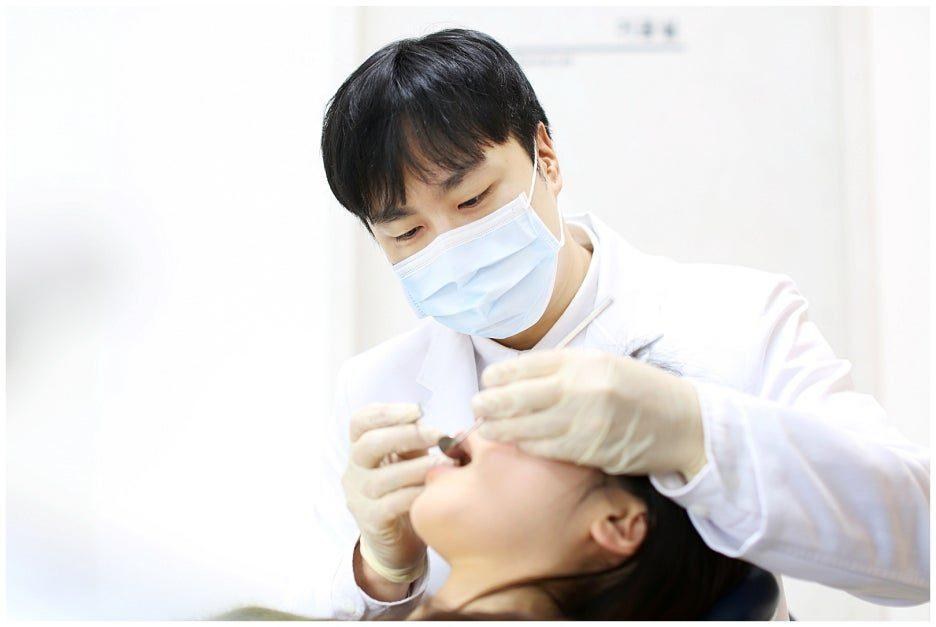
Porcelain veneers are the last step of treatment, so if the gums, teeth, and bite underneath aren't ready, they don't last long. “Isn't it done once they're bonded?” We hear this often, and even if it looks fine right away, the margins look different a month or a year later. We also spend time on diagnosis because porcelain veneers are not always the best choice.
| Check | OK to bond | Postpone or change plan |
|---|---|---|
| Gums | Inflammation has settled | Swollen and bleeding |
| Cavities | Treatment is finished | Decay remains |
| Surface to prepare | Enamel remains | Dentin widely exposed |
| Bite | Force is shared across several teeth | One tooth touches first |
| Alignment | Teeth sit inward with space left | Teeth stick out or overlap a lot |
What happens if there is gum inflammation or a cavity?
If veneers are bonded while the gums are swollen or bleeding, inflammation continues at the restoration margin, and the gums can look dark red or recede. If a cavity is covered over and bonded, it keeps progressing underneath. That's why we finish scaling, gum treatment, or cavity treatment first and then bond. If there is tartar at the gum margin, bleeding during the impression or bonding can also weaken the bond. Gums usually take 1–2 weeks to settle.
Why is the prepared surface kept within the enamel?
Because enamel is the surface that bonds best. If more is removed and dentin is exposed, the tooth becomes sensitive and the bond weakens. The enamel on the front of the front teeth is thinnest near the gums, around 0.3mm, and gets thicker toward the edge, so even when the same thickness is removed, the gum side reaches dentin first. Enamel that has been removed does not grow back. So whether to prepare the tooth is decided not right before bonding but after first checking whether the tooth sticks out, and even if we reshape it, we stay within the enamel. How much is removed is described in detail in How much tooth is removed for porcelain veneers?
Why is the bite checked?
If the upper and lower teeth hit one tooth hard first, that veneer chips or comes off. Rather than making a strong bite rely on thickness, we adjust it to spread the force, and if you grind your teeth, we also consider a protective appliance. If you have a habit of biting through dried squid or ice with your front teeth, we talk about that first too. For the same reason, we check again about 1 week after bonding and smooth out contact points that show up with use.
If veneers are bonded right away while the alignment is far off, more tooth has to be removed or the restorations get thicker to make the teeth look even. In that case, we put tooth-moving treatment first.
How we do it at Wonjin Dental
I talk about the remaining gum problems and cavities before the porcelain to be bonded. If the teeth sit inward and there is space, I consider Brinate, which is placed on top without preparation, and if the teeth stick out or there is a skeletal protruding mouth, I don't place it. Brinate comes in Basic 0.3mm (same day possible), Build-up 0.1mm (about 1 week), and Platinum 0.1mm (about 2 weeks), with no anesthesia and no temporary teeth. Even so, if gum problems or cavities remain, it is not a day for bonding. If it can't be done, I say it can't be done, and I don't cover things up and bond.
Frequently asked questions
How long do porcelain veneers last?
We don't state a fixed number of years. It depends on chewing habits, the bite, and care of the gum margin, and regular checkups of the margins and bite help them last longer.
Can veneers be bonded on the day of the exam?
If there are no problems with the gums, cavities, or bite, and it's a case that can be made the same day, like Basic Brinate, it is sometimes possible. If there is treatment left to do, we finish it first and then set a date.
If a cavity is found in the exam, how long are veneers delayed?
Small cavities are often treated with a composite filling and then we proceed right away; deep cavities may take a few more weeks because the nerve's condition needs to be checked. Depending on the extent of treatment, a different restoration may be more suitable than porcelain veneers.
Why do the gums look dark after porcelain veneers?
They can look dark if gum inflammation continues at the margin, if the color of the tooth underneath shows through, or if the gums recede and expose the margin. Explanations by cause are summarized in Do porcelain veneers cause sensitivity and dark gums?