Why do cavities form between teeth?
Cavities between teeth form when food debris and bacteria remain at the narrow contact point a toothbrush cannot reach. “It looked fine in the mirror, and it was a cavity?” is what people say, taken aback, in the treatment room. It is not because they neglected brushing but because of a structure that is hard to reach.
The enamel (the hardest layer covering the outside of the tooth) on the touching surfaces is thinner than on the chewing surface. Once decay reaches the dentin beneath, it spreads faster and quietly grows inward while the outside looks fine. The spaces between molars are narrower and harder to see, so cavities hide there especially well.
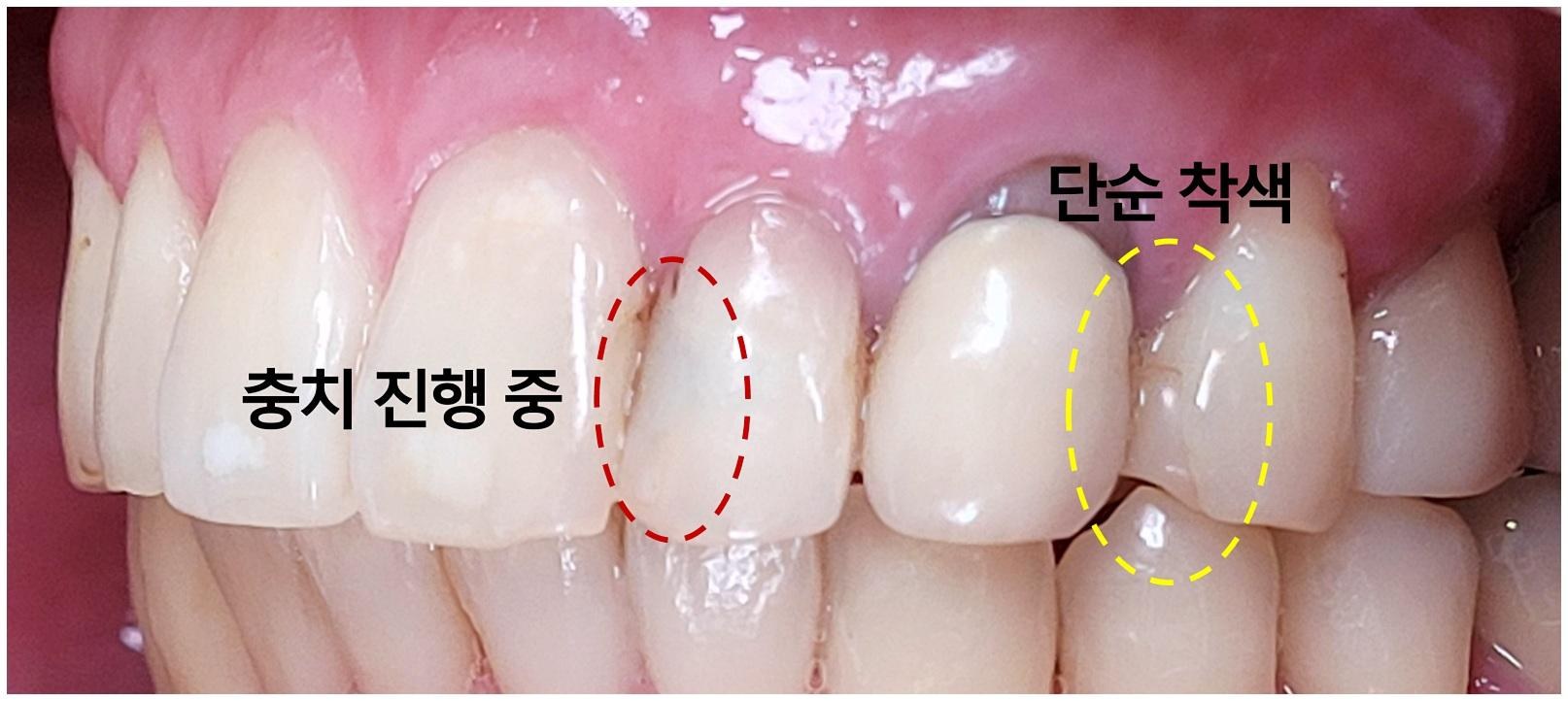
What are the symptoms of a cavity between teeth?
In the early stage there are almost no symptoms; suspect one if you notice the signs below.
- Floss keeps catching or shredding in the same spot
- Brief sensitivity to cold or sweet things
- It feels like something is stuck, though nothing shows in the mirror
- Food often gets stuck in the same spot
If any one of these applies, we look at that spot. The moment it first becomes a little uncomfortable is when the treatment needed is smallest.
Can cavities between teeth only be found with X-rays?
They often cannot be seen with the eye, so X-rays are the most reliable method. By the time a hole is visible on the outside, it has often already progressed quite far inside. That is why, even without discomfort, I recommend checkups including X-rays every 6 months to 1 year.
How do you choose between a composite filling, an inlay, and a crown?
It depends on the extent of the damage and the thickness of the remaining walls. If it is narrow and shallow, a composite filling that fills only that spot often finishes in a day. If it is wide and the contact point and the shape of the chewing surface need to be restored, an inlay, made from an impression, is the better choice.
| Condition | Treatment | Choice to avoid |
|---|---|---|
| Narrow and shallow | Composite filling (interproximal composite ₩300,000) | Shaving widely and crowning |
| Wide, extending to the contact point and chewing surface | Inlay (ceramic inlay ₩350,000) | Getting by with a composite filling alone |
| Thin walls or multiple surfaces, cracked tooth, root-canal-treated tooth | Crown | Repeating fillings over and over |
Prices are as of September 2026 and, including crowns, can be found on the full fee schedule.
What happens if you put off treating a cavity between teeth?
The neighboring tooth gets damaged too, and the level of treatment needed increases. The interproximal surface touches the neighboring tooth, so trying to treat only one side often ends up with both teeth being treated. If it spreads to the nerve, root canal treatment and a crown become necessary.
Cutting down on sugar only slows progression; it cannot reverse a cavity between teeth that has already formed. For prevention, cleaning between your teeth every day with an interdental brush or floss comes first.
How we do it at Wonjin Dental
I don’t assume the touching surfaces are fine just because there is no discomfort. Since these spots can’t be seen with the eye, we check them at intervals, including X-rays, and when I hear that floss has started catching, I check that spot first. Even when the outside looks fine, the touching surfaces can hide decay.
When deciding on treatment, I start with the method that preserves the most natural tooth. Where a composite filling is enough, I don’t expand it to an inlay or crown.
Frequently asked questions
Does an early cavity between teeth heal on its own?
A cavity that has formed a hole does not fill itself in. A very early lesion that stays within the enamel can sometimes stop progressing with fluoride and good care, so in that case we may monitor it without drilling. Regular checkups are still needed while monitoring.
Is treatment for a cavity between teeth finished in one day?
Composite fillings are mostly finished the same day. An inlay requires taking an impression, making it, and then bonding it, so it usually takes two visits.
Why do you suggest treating the neighboring tooth too when it seems fine?
This is when the X-ray shows a cavity on the touching surface of the neighboring tooth as well. Because the surfaces are in contact, if only one side is treated, the decay easily spreads back from the remaining side. If the neighboring tooth really is fine, we don’t touch it.
Which lasts longer, a composite filling or an inlay?
For wide areas, an inlay made from an impression is better at keeping its shape and contact point for a long time. For narrow areas, a composite filling is enough. Either way, lifespan depends on whether you clean the margins every day and on chewing force.